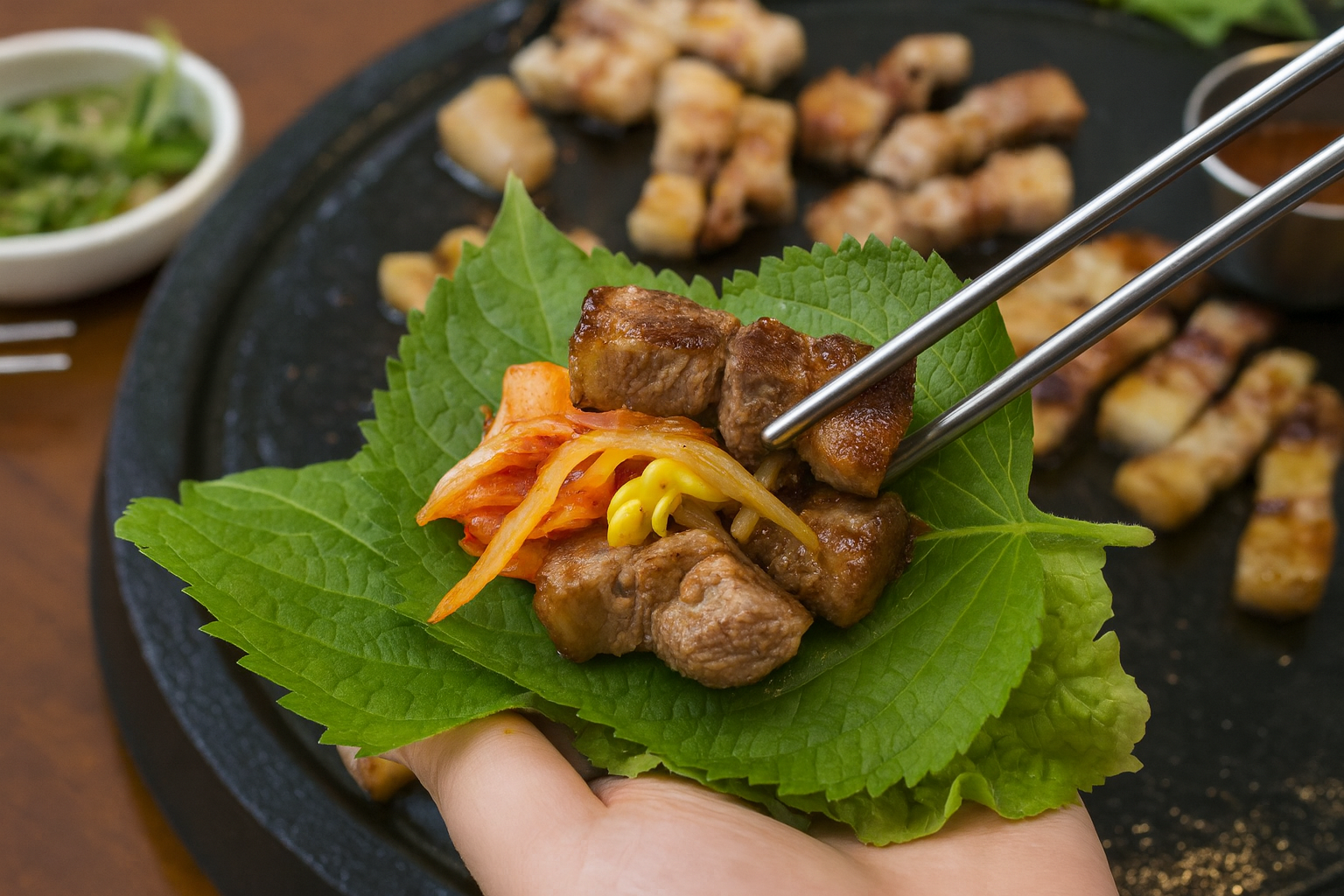
Korean ssam (쌈) — the iconic lettuce wrap filled with grilled meat, rice, garlic, and a dab of ssamjang — is more than a side dish technique. It’s a structured flavor explosion, built in layers and eaten in one decisive bite. For first-time visitors, watching Koreans assemble and inhale a giant lettuce bundle can be both impressive and mildly intimidating — but it’s all part of the fun.
🥩 The One-Bite Rule Every Korean Knows
I once had a foreign friend over for samgyeopsal night. He carefully made his ssam, then politely split it in half to share. I stopped him midair and said, “No, no — ssam is a one-bite deal.” He looked confused, then tried to fit the whole thing in his mouth and laughed, nearly in tears. It looked funny, but that’s the rule — if you don’t eat it in one bite, you miss the full orchestra of flavors hitting at once.
Usually, we use a big leaf — lettuce, perilla leaf (깻잎), or napa cabbage. On it goes a bit of rice, a slice of grilled meat, maybe a sliver of garlic or chili, a touch of ssamjang (that thick soybean-chili paste), and sometimes even a slice of kimchi. Then — fold, lift, and gone in one bite. It’s a simple formula, but somehow endlessly satisfying.
The word “ssam (쌈)” literally means “wrap.” Historically, Korean farmers ate ssam as a portable meal during busy planting or harvest seasons — easy to carry, easy to eat, and full of energy.
🌶️ Ssamjang: The Flavor Glue That Holds It All Together
If ssam is architecture, ssamjang is the cement. It’s thick, salty, nutty, and slightly sweet — a mix of doenjang (fermented soybean paste), gochujang (red chili paste), garlic, onion, and sesame oil. Even if you don’t know how to cook Korean food, this sauce alone can turn any grilled meat into a mini celebration.
Some people like their ssamjang sweeter, others spicy, and every Korean household has its own version. It’s the secret ingredient that balances the fatty richness of pork belly and the crunch of fresh vegetables. Without it, ssam feels incomplete — like a sandwich without sauce.
In Korean BBQ restaurants, the number of side dishes often signals how generous the place is — but ssamjang is the one thing that never changes. It’s always free, always refilled, and always essential.
🍽️ A Flavor Geometry Worth Trying
To outsiders, the idea of wrapping meat, rice, garlic, chili, and paste all at once might seem chaotic — but that’s exactly what makes ssam unique. Every layer adds contrast: spicy and cool, soft and crunchy, smoky and fresh. There’s no right way to build it, only the fun of experimenting with each bite.
So next time you try Korean BBQ, skip the knife and fork. Grab a leaf, pile it up, and take the whole bite — just don’t try to share it. You’ll understand why Koreans look so satisfied when they eat ssam: it’s fast, bold, and brilliantly engineered for flavor efficiency.
'🌿 Discover Korean Culture > 🍲 Korean Food & Dining Culture' 카테고리의 다른 글
| 🧄 Garlic Everywhere — Korea’s Love Affair with Garlic (0) | 2025.11.02 |
|---|---|
| ☕ Korea’s Mix Coffee: A One-Stick Revolution Brewing Worldwide (0) | 2025.10.27 |
| 🍜 Why Korean Ramyeon Is More Than Just Instant Noodles (0) | 2025.10.24 |
| 🥓 Why Samgyeopsal Is More Than Just Korean BBQ (0) | 2025.10.23 |
| 🍌 How Korean Banana Milk Became a Global Mood (0) | 2025.10.23 |


